Polymarket at match time: France–Spain, World Cup 2026
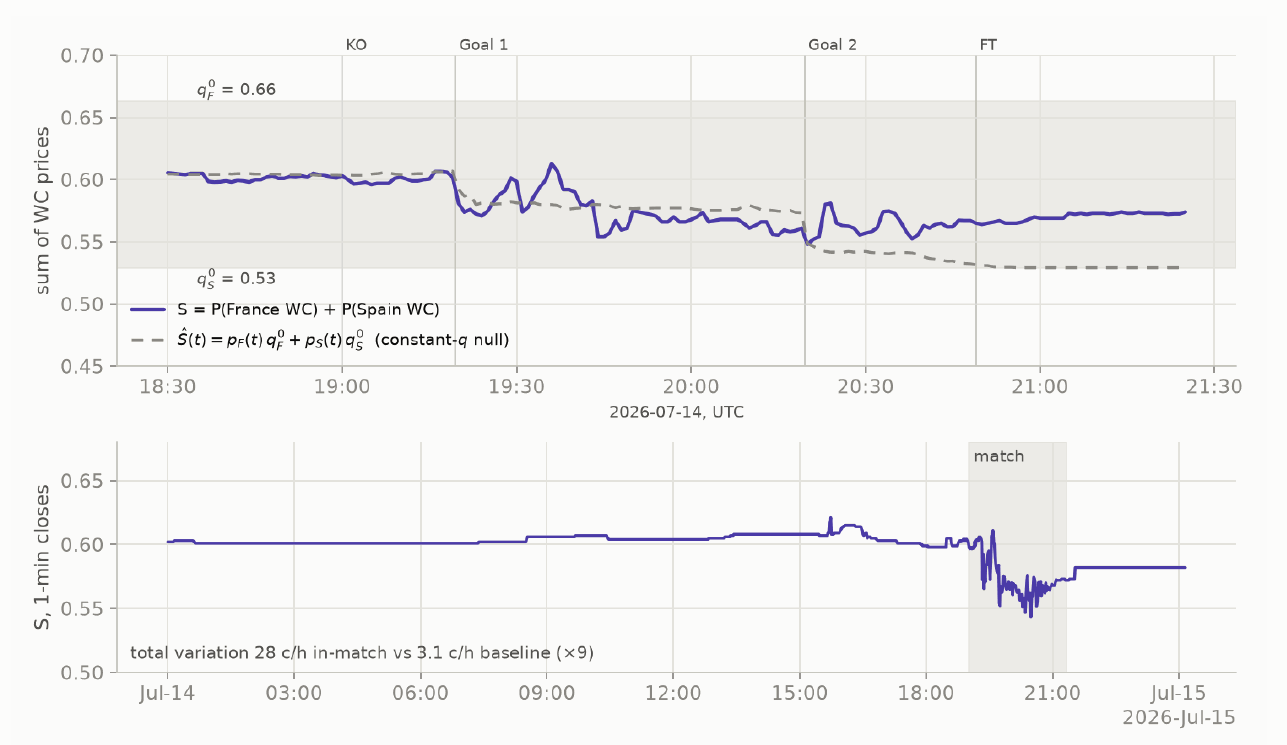
Prediction markets are increasingly read as real-time probabilities, but do two linked markets actually agree with each other? The France–Spain World Cup semi-final of 14 July 2026 is an ideal test. The match market and the World Cup winner market are tied by an exact no-arbitrage relation, so any gap between them is a real inconsistency. Both are deep (over $130M traded on the match, about $4.3B on the winner market), and goals are sharp, precisely timed shocks.
I rebuilt every trade from the Polygon blockchain, 846,502 fills in total, and measured how each goal travelled from one market to the other.
What I found:
- Prices move fast and by the right amount: the winner market is half-repriced within 10–20 seconds of a goal, by the size theory predicts.
- Both markets start trading again within the first two-second block after each goal.
- The clearest inconsistency is a slow re-rating of the losing team: France's implied strength drifted about 12 cents over the hour after the first goal, with no news to explain it.
- The teams not playing, England and Argentina, moved only a few cents, as the four teams' prices rebalanced to sum to one.